FDM 3D Printers
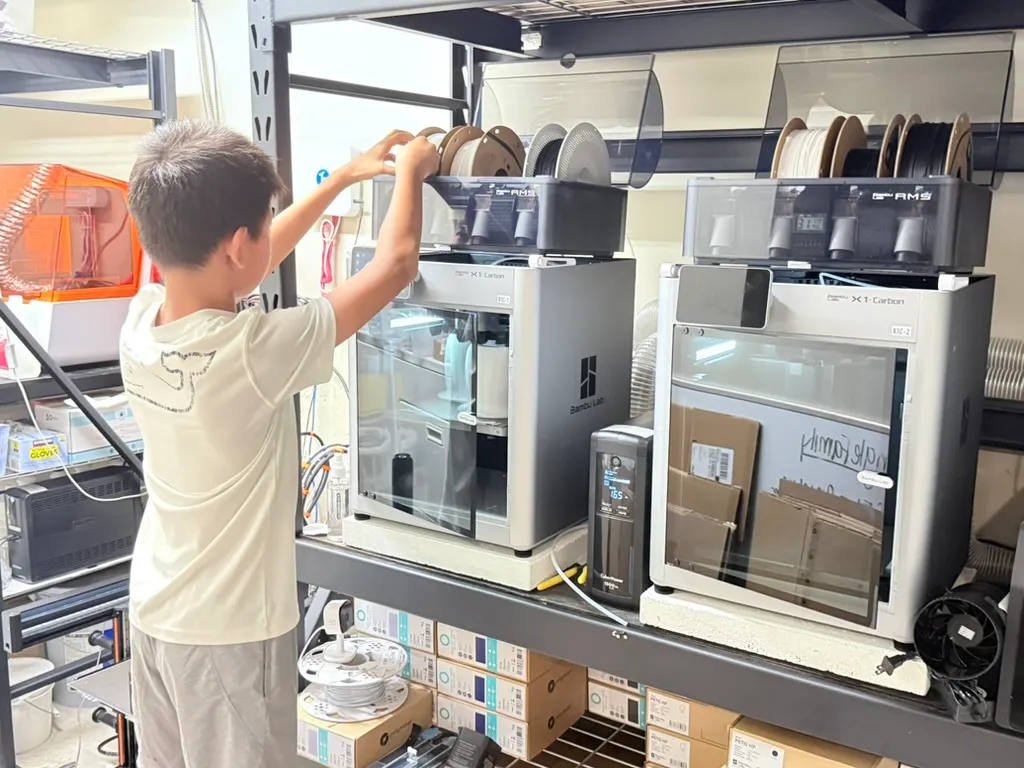
Fused Deposition Modeling is the workhorse of robot prototyping. Our shop runs multiple FDM printers simultaneously, giving teams the ability to iterate rapidly: turn a CAD model into a physical part in hours, test it, redesign, and repeat.
About the Process
FDM printers work by melting thermoplastic filament and extruding it layer by layer onto a build plate. Each layer fuses to the one below, building up the part from the bottom up. The process is fast, affordable, and capable of producing parts strong enough for most robot applications.
Material choice matters: PLA is rigid and easy to print; PETG has better impact resistance and heat tolerance; TPU is flexible and grippy, useful for intake rollers or compliant mechanisms. Students learn to match material to application.
Specifications
- Process Fused Deposition Modeling (FFF/FDM)
- Materials PLA, PETG, TPU (flexible), ABS
- Typical Layer Height 0.1–0.3 mm
- Typical Tolerance ±0.2–0.5 mm depending on geometry
- Quantity Multiple units available for parallel prints
What Students Learn
- CAD-to-print workflow: exporting, slicing, and post-processing
- Slicer settings: layer height, infill, print speed, supports
- Support strategy: when to use supports and how to minimize them
- Material selection: PLA vs. PETG vs. TPU for different applications
- Designing for FDM: draft angles, wall thickness, bridge limits
- Tolerancing for fit: clearance holes, press fits, snap fits
- Quality assessment: reading layer adhesion, stringing, warping
Robotics Applications
- → Motor mounts, servo horns, and custom bracket geometry
- → Intake rollers and custom wheel hubs (with TPU for grip)
- → Sensor mounts and camera brackets
- → Structural spacers and standoffs with custom geometry
- → Rapid proof-of-concept parts before committing to CNC or SLS
- → Replacement parts during competition season
Want to Use This Equipment?
Join FutureForward and get hands-on access to our full fabrication shop from day one.
Apply Now