Formlabs Fuse 1 & Fuse 1+
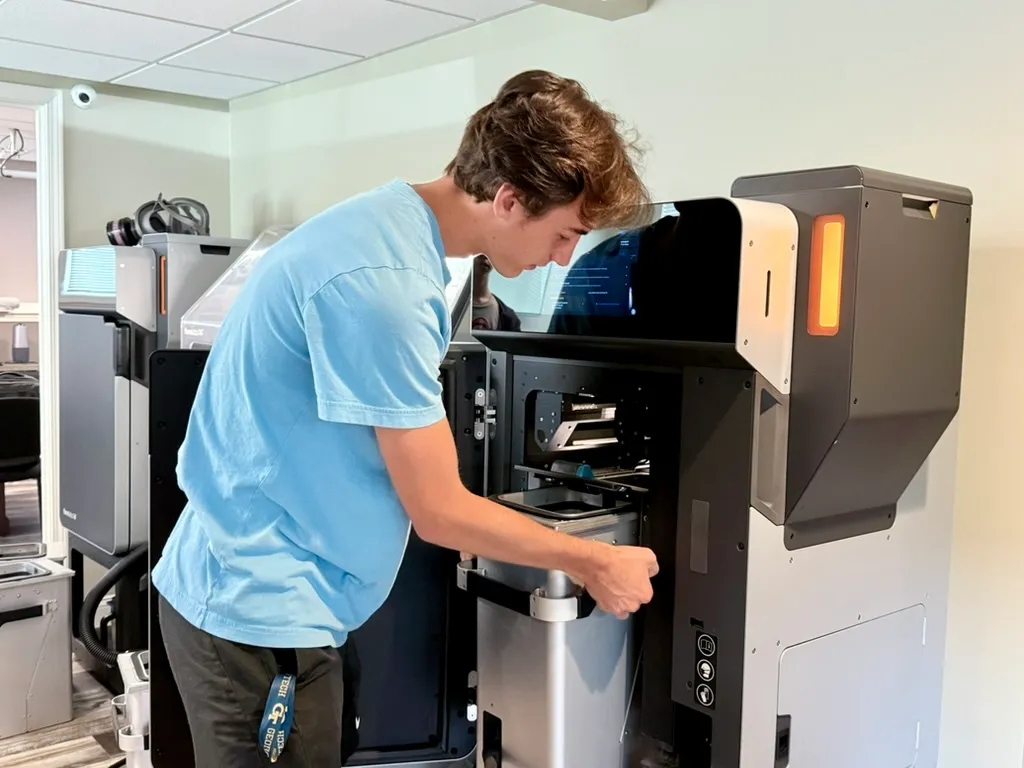
Selective Laser Sintering is the gold standard for functional 3D-printed parts. The Fuse 1 and Fuse 1+ print in PA-12 Tough Nylon and flexible TPU without any support structures. Complex geometry and assemblies are possible that would be impossible on FDM or SLA.
About the Process
SLS works by spreading a thin layer of nylon or TPU powder across a build chamber, then using a CO₂ laser to selectively fuse the powder where the part geometry exists. Because unfused powder surrounds the parts, no supports are needed. Parts simply nest in the powder bed at any orientation.
After printing, the build chamber is removed and allowed to cool. Parts are extracted from the powder cake, and excess powder is cleaned off using media blasting. The resulting parts have isotropic mechanical properties, with equal strength in all directions, unlike FDM where layer adhesion is always a weak point.
Two Key Materials
Specifications
- Models Formlabs Fuse 1 & Fuse 1+
- Process Selective Laser Sintering (SLS)
- Build Volume (Fuse 1) 16.5 × 16.5 × 30 cm (6.5 × 6.5 × 11.8 in)
- Layer Height 110 μm
- Materials PA-12 Tough Nylon (rigid), TPU 90A (flexible/compliant)
- Supports Required None; parts nest freely in powder bed
What Students Learn
- Powder bed fusion process: how a laser sinters nylon powder layer by layer
- Material selection: PA-12 Tough Nylon (rigid) vs. TPU (flexible/compliant)
- Designing for SLS: no support constraints, nesting for efficiency
- Part orientation strategies for strength and accuracy
- Post-processing: powder removal, media blasting, and surface finishing
- Comparing SLS vs. FDM and SLA: when each process is the right choice
- Functional part design: living hinges, snap features, compliant mechanisms
Robotics Applications
- → Structural robot chassis components in PA-12 Nylon, stronger than FDM
- → Compliant intake fingers and grippers in TPU for controlled grip force
- → Complex assemblies printed as a single part (no assembly required)
- → Lightweight structural brackets with organic topology-optimized geometry
- → Functional prototype mechanisms for full load testing before season
- → Replacement mechanisms that can be reprinted identically mid-season
Want to Use This Equipment?
Join FutureForward and get hands-on access to our full fabrication shop from day one.
Apply Now